Editor’s Note: Debi weaves strands of life stories of her own and her fascinating neighbor into a whole piece.
**
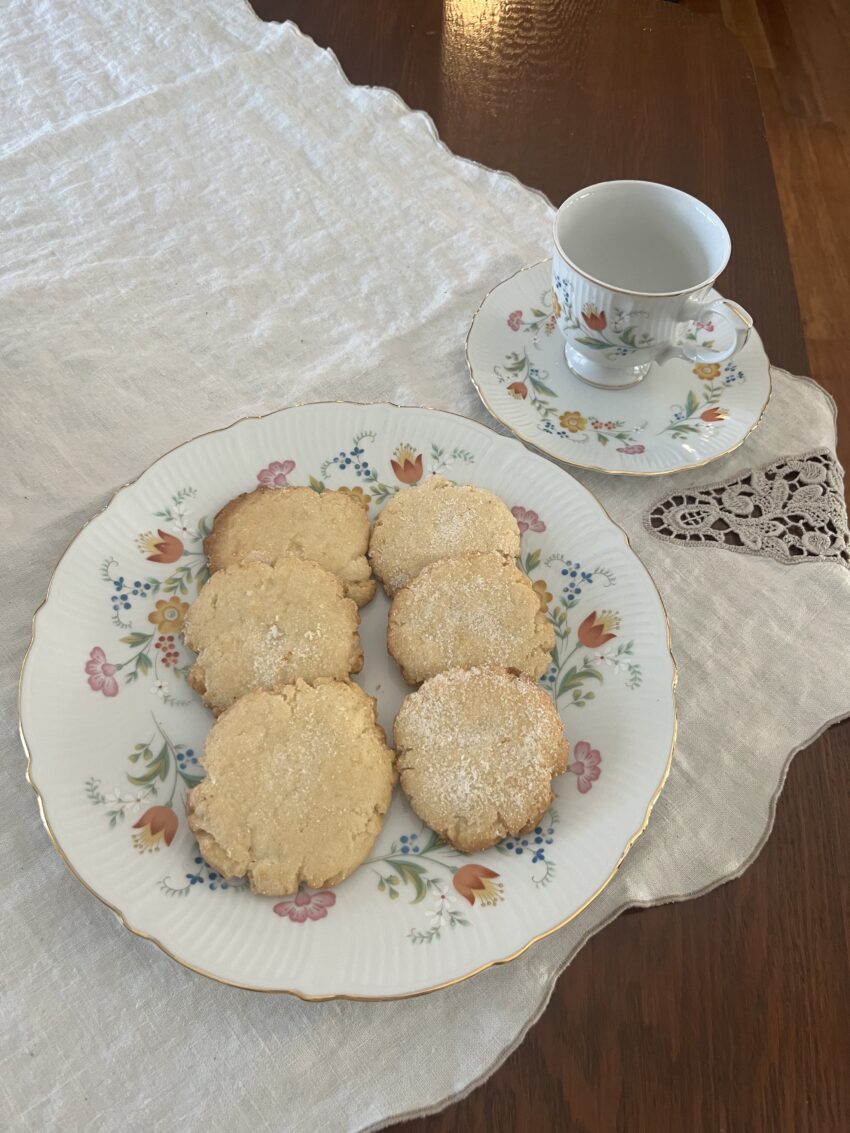
We moved to the house at 312 N Huron in Spring Valley in 1972. It was our first home and we had only been married for a year. There was a quaint cottage-style home next door that we heard was owned by an older woman. She brought us sugar cookies. They weren’t ordinary sugar cookies, but richer, more buttery ones and they were cold. “I keep them in my freezer, always have a dozen or so on hand,” she said. We gladly accepted the plate, a China plate with pink roses on the sides. “I always give these to friends on this plate. It’s very old and I need it back. That way, I know I will see you again,” she said.
Her name was Lucille Chipman. She was a small woman, dressed impeccably, very articulate with flashing blue eyes that belied her age. She seemed very old to me. Looking back, it makes me laugh; she was 69 and I was 22.
After long days settling in, I finally baked brownies and put them on that China plate and returned it. She asked me to stay for tea. It would become a wonderful ritual between us.
I found out she was an English teacher for many years, then received a master’s in counseling and briefly worked at a high school. She had married as a 40 something to a man she fell in love with at 19.
In 1922 she finished her first year of “normal school” as college for teachers were then known and came home to her family farm for the summer. Her father had said a woman didn’t t need a college education. She was just going to get married anyway. But her mother supported her in her quest for learning.
That summer Harry Chipman knocked on her front door. She answered it. He was a travelling insurance salesman and asked if could speak to her father. She laughed. “You don’t know much about farming, I guess,” she said. “No farmer has time to sit down and talk in June, but you can come in anyway.”
She fixed him a cold drink and they chatted. She asked many questions. He made her laugh. He asked if he could call on her the next day. She said yes. They courted through the summer and then it was time to return to school. Harry asked her to marry him and she said yes, she would marry him in three years after she finished college. He said he would not wait. They would get married soon or not get married. She told me no man was going to give her an ultimatum and though she loved him dearly, she returned to college in September. She had introduced Harry to her family, aunts, uncles and the like and he called on her cousin Helen who reminded him of Lucille. They married six months later.
Lucille was saddened but went on to graduate and then to have an extensive teaching career and many adventures. In the summers she loved to travel. Her sister Eleanor, who had followed Lucille to college, accompanied her on these travels. Their favorite trips were to countries abroad. As two single women, they had to hire an escort during their travels aboard ship, and they were a constant presence as they saw the sights.
They were in Paris during the time of the “Lost Generation”. Hemingway and other famous writers met frequently in Paris, primarily during the 1920s (roughly 1921-1928), frequenting cafes like Le Dôme and La Coupole, discussing art and literature with figures like Gertrude Stein, F. Scott Fitzgerald, James Joyce, and Ezra Pound. They gathered to write, drink, and exchange ideas, creating a vibrant expatriate community. It did not take long until the sisters discovered these cafés. Two English teachers with a love of literature sat in awe as they eavesdropped upon conversations between people who one day would become historical icons.
Me, this little farm girl, had a crush on Hemingway since the first time I read his work, dreamed of F. Scott Fitzgerald and was mesmerized by Lucille’s stories. The years passed and many sugar cookies and tea passed between us.
In September of 1975 our little Mariah joined our family. Lucille would come over and insist on watching her during her naps so I could have time to myself. She’d sit on the edge of the bed, the crib nearby and just watch her sleep. Sometimes I went for a walk. Sometimes I went to the library knowing how much she enjoyed our little bundle of joy while I cherished that alone time.
One day as I returned from a walk, she hemmed and hawed and shyly asked me if she could be our daughter’s Grandma. I eagerly agreed. No longer Lucille, she seemed to take great joy when we called her Grandma.
We loved our time together. She’d entertain me and my husband Pat with stories of her childhood. She and her family took the wagon and horses to Forestville to see Annie Oakley and the Wild West Show. She taught for several years in Eveleth in Northern Minnesota. She told of the time a bear surprised her as she arrived at the one room schoolhouse in the early morning darkness. She chased him out as she had to build a fire to warm the schoolhouse, a necessity before students arrived.
After more sugar cookies and time went by, I had to satisfy my curiosity: I finally asked her how she ended up marrying Harry Chipman. Her story is worthy of a TV movie.
Because he married her cousin, she saw him from time to time at family functions. He went on to build one of the most prestigious insurance companies in Iowa. He and Helen had no children, but had a good life, traveled some, and were proud that he became friends with the Wilder family — as in Laura Ingalls Wilder.
At one such gathering, he was regaling the family with his story of meeting Laura after she became well known for the Little House series. The family was impressed until she and Eleanor told of their encounters with the writers in Paris. Harry chuckled and she said she felt smug.
Many years passed and Helen passed away. Of course, Eleanor and Lucille went to the funeral. Lucille told of waiting by Helen’s gravesite after other mourners had left. “I looked at the casket and leaned down and whispered, “You might have had him for many years, but I’ll have him in the end.” Indeed, she did. Harry and Lucille were married after the customary one year of mourning. She enjoyed his good health, his wealth, and their years together. “Not enough,” she said.
Many pictures of her life adorned the shelves in her library in her charming home. Each one held a story. She was a good neighbor, but she began to be even more frail and called upon my husband for help. He devised a method for her to let us know she was safe each morning. He made a US flag to put in her kitchen window. Each morning one of us would look to make sure it was there. One day, the flag did not appear. With trepidation, Pat went over to her house and used the spare key to open the door. He called out and heard a weak reply. “In the bedroom,” she said. He rushed to the back and opened her bedroom door. She was lying on the bed, dressed in a long formal gown. She could barely lift her head. “What in the hell happened,” he asked. It seems she had come home that night from an Eastern Star dinner and was trying to get the zipper down on the dress. Having difficulty, she laid on the bed attempting to wiggle out of it and the zipper got caught on the bedspread. She was trapped! So she covered herself as best she could and had a “remarkably good night sleep.” Pat helped her with the zipper and she seemed more embarrassed that he saw her silk slip than the fact she was trapped in her bedroom for a night. She told her many friends that a “man had helped her undress” and had many a laugh from the incident.
More years passed and she sold the home and moved to a senior apartment, Charter House, in Rochester. We were invited to join her for the evening meal many times, always reminded by her that it was “a bit of a formal affair” meaning white tablecloths, and no jeans.
We sold our home and rented while we built a log house in the country. In 1979, we adopted our son and she was thrilled to have a baby in her arms when we visited. Eventually she moved into the nursing facility in her building. She was happy that we accepted her gifts as she downsized. We perused a large collection of poetry and novels from her college days. Mariah wore Lucille’s confirmation dress in a Historical Society fashion show. She gave us her steamer trunk; I often wish it could talk and tell tales of her travels. We enjoyed her famous sugar cookies which remain a favorite of my son and daughter and are sure to be a favorite of the grandchildren as well.
Lucille succumbed to pneumonia at the age of 90. We are often reminded of Lucille and her tenacity when we’re faced with obstacles of our own.
Her cookies were served at her funeral.
Copyright © 2026 Debi Neville
Your family was blessed totally blessed to have this grandma. My children too found their Amercan grandma and grandpa in Queens, NYC, who entertained us with lovely stories of their travels, fed us cakes and cookies. So fortunate to have had them.
Oh Debi, I love your stories! “Grandma” came to life on the page, chasing the bear away from the school, listening avidly to the literary elite, getting Harry Chapman “in the end” and finding herself trapped by her gown zipper in her own bed. What a life! Thanks for sharing her with us!
Reminds me so much of my own dear grandma, Ruth Wolfgram, who also lived on Huron Ave, on the corner, about the same time period. Chase antiques was the next house to the north.
I remember her!! Sweet woman!
A very interesting and charming story. What a gift she was to your family.